Former SCC Upward Bound student Daniel Sevigny, Director of Restorative Justice for Rowan County, directs an initiative that has just been ranked number one in the nation.
Sevigny, a graduate of Franklin High School, is the Project Director of Reclaiming Futures. This is a national initiative to change the way courts, judges and the Juvenile Justice Department view and treat juveniles who come into the court system with past/present substance abuse and mental health issues.The Rowan County site just received notification from the national office that they are number 1 out of 29 sites in the nation in assessing youths needs, engaging youth in treatment programs and treating underlying substance abuse/mental health issues. Once treatment is completed, the youth are re-engaging back into the community.
The Reclaiming Futures Model has been accepted as the way to track youth throughout the process and Savigne and his colleagues will be presenting the data in May to the heads of Juvenile Justice programs throughout the nation.
The first step in paying for college is to apply for federal aid by completing the online FAFSA (Free Application for Federal Student Aid) at www.fafsa.ed.gov.
For assistance filing your FAFSA, attend FAFSA Day at Southwestern Community College on Saturday, Feb. 18, from 9 a.m. to noon.Register at http://www.cfnc.org/fafsaday. The application web-site is secure and college financial aid staff requires the information to award federal funds to students.
FAFSA requires tax information from the previous year, so complete the application soon after filing taxes and be sure to use the IRS automatic data retrieval option.Whether attending college full or part-time or believe your income too high for eligibility, apply.Certain funds are available no matter your course hours and many merit-based scholarships require the FAFSA.
The primary aid programs annually available through FAFSA are:
·Pell Grant ($555-$5,550)
·Federal Work-Study (minimum of$7.25/hour for part-time work on or offcampus)
·Low-Interest Direct Stafford Loans ($5,500-$10,500depending on eligibility)
·Low-Interest Direct PLUS Loans (amounts vary)
Questions?Call SCC’s financial aid office at (828) 339-4438.
Honors Students and Their Projects- Creating Success!
CUTLINE: Presenting their honors projects during a breakfast Feb. 2 in their honor are Southwestern Community College honors students, from left (seated): Gloria Patterson of Sylva, Brandy Anders of Cullowhee, Meghan Lock of Tuckasegee, ChrisBreeden of Cullowhee; (standing) Joy Hutcher of Franklin, Samantha Greene-Frontauria of Cullowhee, David Hall of Waynesville, Dan Riddle and Carly Pearson, both of Cullowhee.
The effects of the woolley adelgid on the mountain hemlocks, development of Judaism, results of OSHA, a lexicon of Spanish/English for use in the court system, radon gas testing, a PowerPoint on development trauma disorder, creation of an art fresco and a sci-fi magazine highlighted honors program projects presented during a breakfast Feb. 2 honoring students and their completed projects.
From a program that begin in 2008 with four students and two founding fathers, Mike Burnette and Allan Grant, the honors program currently has 41 approved contracts. More than 50 faculty members have been engaged with the program and just recently Vance Waggener made his calculus III class the first official honors class.
Samantha Greene-Frontauria of Cullowhee said she had always wanted to learn about Judaism and how it developed into modern-day religion. “I found this project very challenging because I had to separate my own beliefs,” said Greene-Frontauria, who mentored with sociology instructor Bucky Dann.
As part of her honors project with accounting instructor Diania McRae, Carly Pearson of Cullowhee became so interested and involved in the Volunteer Income Tax Assistance program for the elderly and low income that she took the exam and became a certified VITA volunteer herself.
Dan Riddle of Cullowhee worked with the Spanish community and the legal system for an honors project to create a Spanish/English lexicon for use in the court system. “It’s not always just about the words; sometimes it takes the subtle understanding of the language,” said Riddle, who was assisted by arts and sciences instructor Serena Herter.
Chris Breeden of Cullowhee worked with Writing Across the Curriculum coordinator Jennifer Hippensteel on a project embodying different writing styles that resulted in a 35-page Sci-Fi magazine. “Through the natural writing process I was amazed to watch how the characters changed and the plot evolved,” said Breeden, who plans to publish the magazine.
Writing longer, in-depth papers with intense research and having to defend that research constituted Meghan Lock’s project with English instructor Chris Cox. “I learned a whole lot about literature but I also learned to take my research and apply it to life,” said Lock, who added that she acquired time management skills as a result of her project.
His research with biology instructor Trevor Rundle on the effects of the woolley adelgid on hemlock trees alarmed David Hall of Waynesville who said that if 50 percent or more of the tree is infected, the tree is lost. “I learned how important a single species is in our eco system and how it intertwines with others. In just a decade the loss of the hemlocks will completely change the ecology of our mountains,” Hall said.
While it’s Gloria Patterson’s second go-around at Southwestern, her research on the Occupational Safety and Health Administration was her first honors project. Working with paralegal technology instructor Kelly Burch, Patterson, who lives in Sylva, discovered why OSHA was formed, how it applies to administrative law and its impact on safety in the workplace.
Joy Hutcher of Franklin started back to school at age 60 and jumped right in to an art fresco honors project with instructor Julie Jacobsen. Since this was a totally new endeavor at the Oconaluftee Institute for Cultural Arts, the multi-disciplinary project involved the collaboration ofmany different people, Hutcher said.
Mentoring with chemistry instructor Deanne Oppermann, Brandy Anders of Cullowhee
conducted research about radon gas and tested different homes for elevated radon levels.In her lab report presentation Anders said she learned that this gas, although odorless and colorless, poses the risk of cancer for its consumers.“I will definitely use this knowledge to my advantage when purchasing a future home,” Anders said.
Working this time with psychology instructor Steven Wampler, Anders also conducted research about Developmental Trauma Disorder and developed a PowerPoint presentation on the areas in Jackson County that provide assistance to children of abuse and/or neglect.“I learned that children who are victims of abuse/neglect are often over diagnosed with several different
diagnoses such as ADHD, conduct disorder, PTSD, and oppositional defiant disorder.To prevent these multiple diagnoses, a new proposal has been made to include Developmental Trauma Disorder in the Diagnostic and Statistical Manual of Mental Disorders.”
Vice President of Instruction and Student Services Thom Brooks congratulated the students on their “engagement in activity for learning and personal growth. We applaud your passion to do more, to push yourself beyond normal expectations.”
Honors students can complete half of their university honors college credits with SCC, said Cheryl Contino-Conner, honors program chair. SCC currently partners with Appalachian State University, Western Carolina University, University of North Carolina-Charlotte, UNC- Wilmington, UNC-Greensboro and NC State in this transfer agreement.
National Park Service-Seasonal Law Enforcement Training Class # 87
They came from all over the country, including places like Missouri, the Florida Everglades, California, Nevada, Tennessee, Pennsylvania and Virginia. But they all had one thing in common -their main reason for attending Southwestern Community College’s National Park Service-Seasonal Law Enforcement Training.
Invariably, each of the 29 graduates of NPS-SLET Class of 67 said their reason for attending SCC’s rigorous 16-week program was that rangers in the field recommended it as “the finest program in the country.”
Take Elizabeth Dietzen, who worked as an interpretive ranger at Lake Mead National Recreation area in Nevada. “When I decidedto become a law enforcement ranger, all the rangers told me SCC was the best school,” she said.
Mel Johnson’s story was similar. Like Dietzen, he, too, had worked as an interpretative ranger. “That doesn’t mean we interpret languages,” clarified Johnson, who worked at Everglades National Park in Florida. “As an interpreter you provide information and act in an advisory capacity.”
He pursued his law enforcement certification so he could “be a better defender of the park.” For instance, Johnson said before he could only advise visitors not to feed the bears, but as a law enforcement ranger he can enforce the law.
Already working in a law enforcement capacity in Harriman, Tenn., Chase Tedder took SCC’s program to “expand my skills so I would have new opportunities in law enforcement.”
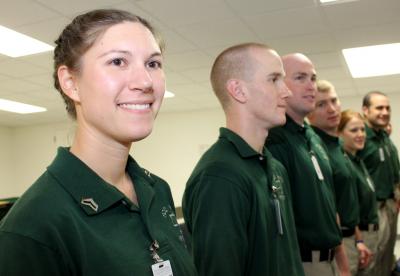
“We learned to think tactically from the moment we entered our training,” said class Corporal Stephanie Salomon, who said the command “Smooth steady press of the trigger!” rings in her head as loud as the firing bullets.
“We had to get our mind set on combat and it become a very high priority to avoid a ground fight,” said Salomon, who lives near Leesburg, Va.
Speaking at the graduation ceremony Thursday, Dec. 8, at SCC’s Jerry Sutton Public Safety Training Center, Salomon told the audience what it felt like to be pepper sprayed and tased. While she joked about “running as fast as you can” to avoid confrontation, she admitted, “Having to use ground defense techniques in real life and seeing how easily you can end up in a difficult fight for your life has a sobering effect.”
After 16 intense weeks, Salomon said with confidence that she and her fellow graduates not only had the basic skills, but the proficiency and mind set as well, to be law enforcement officers.
For more information on SCC’s NPS-SLET program, contact Curtis Dowdle, director of training, at cdowdle@southwesterncc.edu or 828-306-7040.
CUT: Class Corporal Stephanie Salomon, left, at Southwestern Community College’s National Park Service-Seasonal Law Enforcement Training Class #87 graduation Dec. 8.
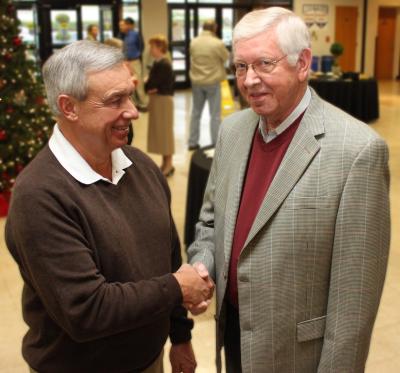
CUT: As the new year approaches, a new leadership takes over at Southwestern Community College as Conrad Burrell, right, chairman of the SCC Board of Trustees for the past 11 years, hands over the chairmanship to Terry Bell, left, of Franklin. Chairman since 2000, Burrell has served longer than any other SCC chairman. Previously the vice chairman, Bell has served on the board since 1995.
“There are not enough accolades to pay you for what you have done for Southwestern Community College,” Paul Holt, founding SCC Board of Trustees member, told Conrad Burrell, who stepped down as the college’s chairman of the board. Burrell has served as the board’s chair for 11 years.
“That’s a long time,” said Burrell, who has served longer than any other SCC chairman. Terry Bell of Otto, vice chairman and an SCC board member since 1995, will take over the leadership role.
“Terry will do a great job,” said Burrell. “We are entering a new year and I think the focus on our new chairman being from Macon County will be a good direction for the college,” said Burrell, a Jackson County native.
“Conrad has been very unselfish in his promotion of SCC, whether it’s Jackson, Macon or Swain County, or the Qualla Boundary,” said Jerry Sutton of Franklin, who has served seven terms as SCC board chairman.
SCC President Don Tomas said the long-term commitment and advocacy of Burrell and other board members drive SCC’s success. “This board has a100 percent participation and you don’t always get that from every board,” Tomas said.
In paying tribute to Burrell, Tomas said, “During Conrad’s leadership SCC has fostered the growth of community and public school partnerships, increased in physical size and enrollment and created innovative methods to minimize local and topographical barriers to education.”
Student enrollment set new records, increasing 54 percent since 2000 when Burrell became chairman, Tomas noted.
SCC has twice been ranked as one of the top ten in the nation among community colleges in a ranking by Washington Monthly Magazine, Tomas said.
Plus, Tomas added, five times out of the last six years, the college has achieved Exceptional Designation from the North Carolina Community College System based on the annual NCCCS performance measures and standards.
“Under Conrad’s leadership SCC built a Macon Campus, opened a new center in Cashiers, developed Early College programs on the Macon and Jackson Campuses and a virtual campus at Blue Ridge and spearheaded BalsamWest Fiber NET,” Tomas said.
Burrell said his biggest challenge, but also his greatest accomplishment, was the purchase of the adjacent six acres of N.C. Forest Service property. “That finally allowed SCC’s Jackson Campus to expand,” said Burrell, who has served on the board 16 years.
“Conrad always had a vision of where SCC could go,” said former board member George Hooper of Cullowhee. “He’s put a lot of thought and work and devoted a large part of his life to getting the college to where it is today.”
Board member Pete Penland of Macon County agreed. “Conrad has given his undivided attention to the college. Ever since he became chairman in 2000, Conrad made the college his number one priority.”
One of the best things about Conrad’s leadership, according to board member Kate Welch of Swain County, is “he never gets rattled.”
“No matter what the situation, Conrad always remains calm and cool and a true gentleman,” said Welch. “Plus, he always expresses appreciation to everybody else but he never takes any credit for himself.”
“Terry is a lot like Conrad,” said Sutton, who served 26 years on SCC’s board. “Terry values honesty, progress and education. He will carry SCC to its next level.”
A native of Macon County, Bell’s career has been dedicated to education.He received a bachelor’s degree in middle grade education in 1974 and a master’s in school administration in 1983 from Western Carolina University. Bell’s career highlights include science instructor in Haywood and Macon counties, principal at Macon Middle School, principal at East Franklin Elementary, principal at Union Elementary School and assistant principal at Franklin High School. He retired in 2009 as director of auxiliary services for the Macon County School System.
“I look forward to serving as board chairman to continue the leadership that Conrad Burrell has provided for several years,” said Bell. “It will be my goal to provide governance to keep Southwestern a top community college.”




 Click
 Click
